The majority of women veterans do not have any mental or physical health difficulties related to their military service. The same is true of the veteran population in general.
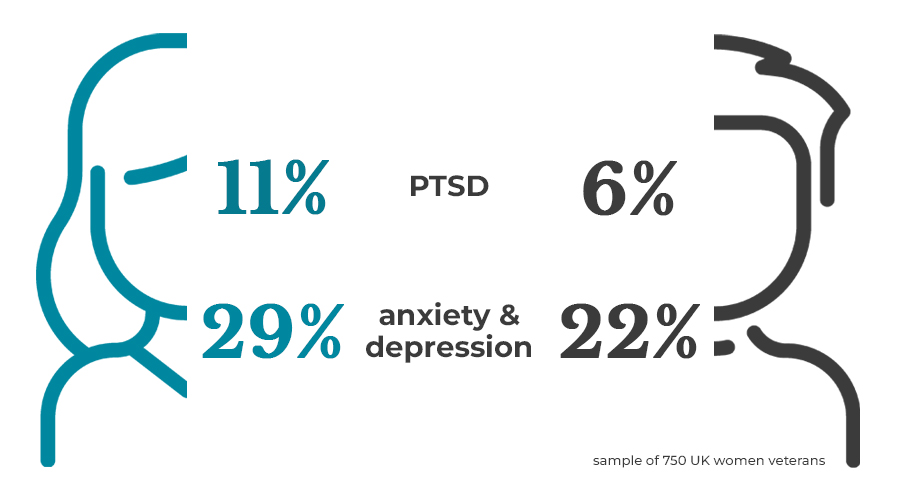
However, women veterans appear to have a slightly different health profile, with a higher prevalence of mental health difficulties when they are compared to the veteran and serving populations as a whole, which are predominantly comprised of men. A study of one sample of UK women veterans found that around 29% reported probable symptoms of anxiety and depression, and almost 11% reported symptoms of probable post-traumatic stress disorder (PTSD). This compares to 22% and 6% respectively of the UK veteran population in general. Although women in general report higher rates of mental ill health compared to men, these rates are elevated across veteran groups.
The challenges during military service discussed previously – such as sexism, feeling excluded, and facing discharge for becoming pregnant – have all been linked with poorer physical health, mental health, and feelings of loneliness as a veteran.
MST has been linked to a two-fold increase in the likelihood of reporting symptoms of PTSD as a veteran in women. This likelihood has been shown to be even higher following sexual assault during military service. MST has also been linked to symptoms of anxiety and depression, disordered eating, chronic pain, and impacts on parent-child bonding in women veterans.
MST may also lead to feelings of betrayal by those responsible, as well as by wider military structures. Such betrayal can violate deeply held moral beliefs and lead to lasting feelings of guilt and shame. This is sometimes referred to as ‘moral injury’ where the relationship an individual has with themselves and others is deeply impacted.
(SOURCES: Hendrikx, Williamson et al. 2021; Stevelink et al. 2018; Hendrikx et al., 2021; Surís et al., 2004; Goldstein et al., 2017; Shapiro et al., 2023; Breland et al., 2018; Creech et al., 2022; Lopes et al., 2023)