Research has shown that women veterans – and other minority groups of veterans – face compound barriers to accessing healthcare and support.
Barriers common across groups of veterans include stoicism, stigma and the idea that support services are inaccessible, unavailable or not applicable to their needs as veterans. For minority groups of veterans these barriers may be further heightened as minority groups can feel ‘othered’, unwelcomed by services, or poorly understood by professionals. For women veterans specifically, a final layer of barriers can then include gender-specific discrimination or the practical impact of accessing help whilst managing caring or childcare responsibilities.
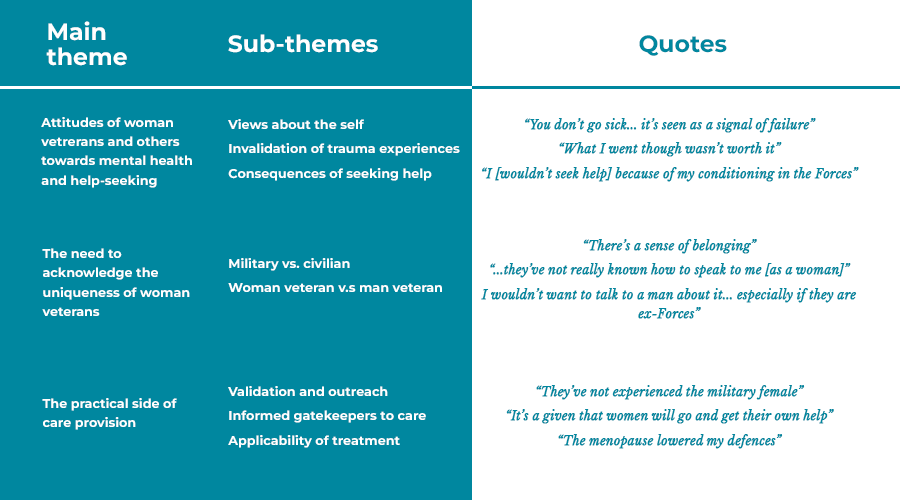
Several research studies have found that the barriers – and also facilitators – to women veterans seeking help broadly fall into three main themes shown in the diagram above: the attitudes of themselves and others towards mental health and seeking help; a need for their uniqueness to be acknowledged as a women, a veteran and a combination of the two; and practical elements of care provision such as a need for greater professional knowledge or better coordination between veteran and women’s health services.
There is evidence that some women veterans do seek help when needed and may do so more readily than their male counterparts. However, this may not necessarily be from veteran-specific or specialist services in the first instance. This may mean that specialist and veteran services need to ensure they are more approachable or applicable to women veterans, as well as these services identifying where women veterans are already going to access help and linking with those first points of contact.
This research has informed the following practical considerations on how to help make sure support services can be more responsive to women veterans’ experiences and needs.
(Sources: Campbell et al, 2023; Godier-McBard et al, 2022)