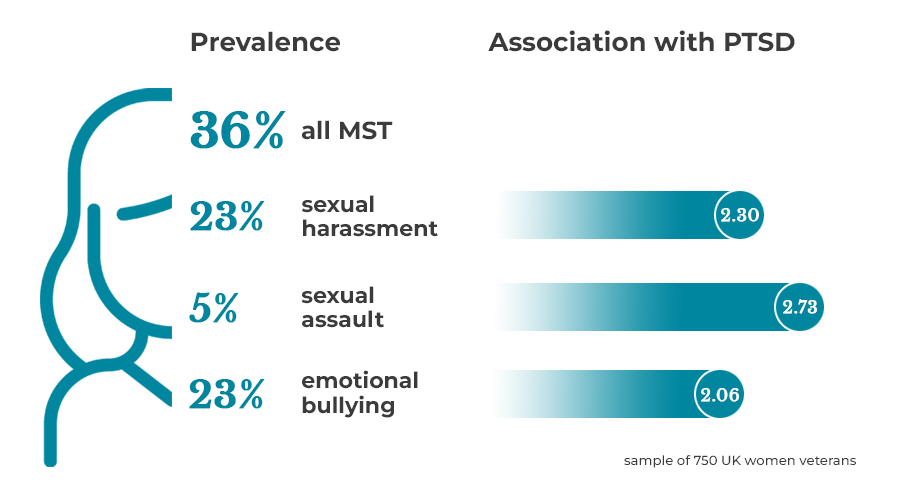
When seeking to understand the mental health profile of women veterans, one in-service experience to consider is ‘military sexual trauma’ or MST. MST is an umbrella term used to describe a continuum of violence encompassing sexual harassment and assault that takes place during service and is perpetrated by other service personnel. Harassment can also typically include bullying and discriminatory comments or behaviours based on gender. There is currently no universally accepted definition of MST and it continues to be a debated term. Women are disproportionately the targets of MST during military service, although the greater proportion of men in the military may mean absolute numbers are comparable.
MST has been linked to a variety of health problems. It has been identified as a potential leading cause of military-linked PTSD in women veterans. The graphic above shows that in a sample of UK women veterans, the odds of experiencing PTSD symptoms as a veteran are increased for those who experienced MST during their service. It is highest for women who have experienced sexual assault during military service. In this study, those women veterans were nearly three times more likely to report PTSD symptoms compared to women veterans who haven’t been sexually assault during service.
MST can be considered unique because of the environment it occurs in. MST has been associated with different mental health, physical health and social satisfaction outcomes when compared to other military specific traumas or similar traumatic experiences such as sexual harassment and assault that take place before or after military service. The all-encompassing nature of the military environment can make it challenging for victims to escape or report abuse, particularly if they have to live, work and socialise alongside their perpetrators. Fear of occupational repercussions have been discussed by women veterans in research; some veterans also report feeling ‘institutionally betrayed’ by the military or by colleagues. This can potentially impact the relationship an individual has with themselves and others.
We will return to the topic of MST later in this course. However, understanding all of these broad factors can help inform how services can support women veterans, and in particular those who have experienced MST.
(SOURCES: Gray et al., 2023 ; Herriot, Campbell et al., 2024; Hendrikx et al., 2021; Newins et al., 2021 ; Surís et al., 2004; Wilson, 2018)